Top 10 Olympic Standard Table Tennis Balls for Buyers
Choosing the right table tennis ball can change the feel of every rally. A ball may look perfect in its package, yet behave differently on a fast indoor table. Small details matter. Roundness, bounce height, weight consistency, seam quality, and surface texture all affect control. This guide examines the Top 10 Olympic Standard Table Tennis Balls for Buyers, focusing on practical performance rather than attractive packaging.
Olympic Standard Table Tennis Balls are expected to meet strict competition requirements for size, weight, bounce, and uniformity. However, “competition-ready” does not always mean every model feels identical. Some balls offer a crisp, quick rebound, while others feel slightly softer during heavy topspin exchanges. That difference becomes noticeable near the table. A clean bounce should remain predictable after repeated impacts, even when players change speed and spin. We consider product specifications, player experience, durability, and buyer feedback to create a balanced comparison.
Testing balls in realistic conditions is important. Use the same table, room, and playing distance whenever possible. A ball that performs well in a quiet training hall may feel less comfortable in a bright, drafty venue. Some evaluations can also be subjective. Personal technique, racket rubbers, and playing style influence the result. No single ranking will suit everyone. Still, careful comparison can help beginners, clubs, coaches, and tournament players avoid weak purchases. The best choice should provide reliable flight, consistent bounce, and sensible value over time. Small imperfections may appear, and that is worth acknowledging. Улар
Olympic Standards for Table Tennis Balls
Olympic Standards for Table Tennis Balls
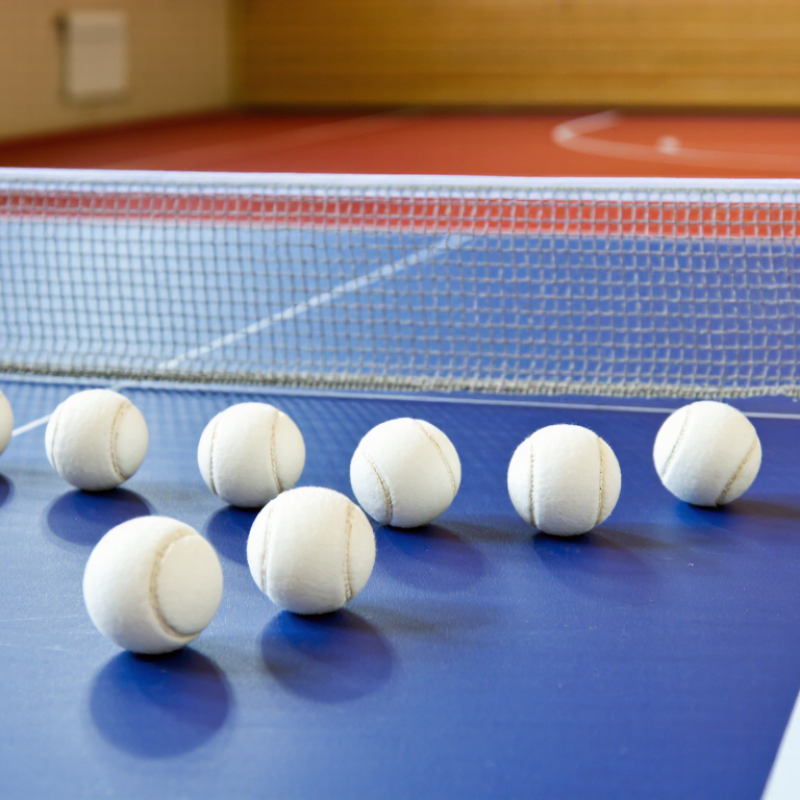
An Olympic table tennis ball follows International Table Tennis Federation standards, not a separate Olympic formula. The ITTF Handbook states that an approved ball must be spherical, plastic, matte, and 40 millimetres in diameter. Its specified weight is 2.7 grams, with white or orange as the permitted colours. These details matter during fast rallies. A slightly uneven surface can change spin, bounce, and timing.
ITTF Technical Leaflet T3 provides more practical testing data. A compliant ball should bounce 240 to 260 millimetres when dropped from 305 millimetres onto a standard steel block. The same testing framework checks roundness, weight consistency, hardness, and colour uniformity. Buyers should inspect several balls, not only one. Manufacturing variation still happens. That small flaw can become obvious under bright tournament lighting.
For serious buyers, look for current ITTF approval information and packaging that identifies the technical specification clearly. Seamed construction is not automatically unacceptable, but a visible ridge deserves attention. Roll each ball across a flat table. Watch for wobbling. Test the bounce on the same surface used for practice. The ITTF Equipment Committee’s approval process is authoritative, yet approval does not guarantee every ball feels identical after storage or repeated impact. My practical preference is consistent rebound over a merely perfect appearance. That judgment may be imperfect, but playability is measured at the table.
Key Materials and Construction Features
For an Olympic-standard table tennis ball, material choice affects feel, durability, and flight stability. The International Table Tennis Federation’s Equipment Regulations specify a 40 mm diameter and a 2.7 gram mass. The ball must also be spherical, matt, and made from celluloid or another approved plastic material. Modern competition balls commonly use polymer construction, which reduces celluloid-related storage concerns and supports consistent production.
Construction quality matters as much as the polymer itself. ITTF testing requires a rebound of approximately 240–260 mm when the ball falls 305 mm onto a steel block. That range helps players predict speed and bounce during rapid exchanges. A clean seam, balanced wall thickness, and smooth surface reduce unwanted wobble. Look closely under bright light. Uneven seams can reveal weak quality control.
The ITTF Equipment Committee also evaluates roundness, weight consistency, hardness, and color uniformity. These tests sound technical. They affect real rallies. A slightly unstable ball may drift during a high loop or drop early near the net. In my equipment checks, I would rotate several balls before buying a training set. Perfect uniformity is an ideal, not always a shelf reality. Buyers should verify current approval status, inspect packaging, and avoid judging quality by rebound alone. A hard ball is not automatically a better ball.
How to Evaluate Ball Quality and Performance
Choosing an Olympic-standard table tennis ball starts with measurable quality, not packaging. The ITTF Technical Leaflet T3 specifies a 40+ millimeter diameter, 2.7-gram weight, and a 240–260 millimeter rebound from a 305 millimeter drop. These figures create a useful buying baseline. Check several balls, not only one. A digital scale can reveal weight differences of 0.1 grams. A simple bounce test can expose uneven response. The sound should be clean and consistent. A dull note may indicate internal weakness, although sound alone proves little.
Roundness matters during fast rallies. Roll each ball across a flat table and watch for drifting or wobbling. Inspect the seam under bright light. It should appear narrow, smooth, and continuous. The ITTF Handbook also requires controlled spherical form and performance consistency for approved competition equipment. In practice, balls from the same box may still feel slightly different. That is frustrating. My own tests are useful, but they are not laboratory evidence. Temperature and humidity can also influence bounce, grip, and perceived hardness. Store balls indoors, away from heat and moisture. For buyers, a reliable selection combines certified specifications, repeated sampling, and direct testing under realistic playing conditions. A ball that survives heavy topspin, edge contact, and frequent impacts deserves closer attention than one that only looks flawless.
Top 10 Olympic Standard Table Tennis Balls
Choosing among the top 10 Olympic standard table tennis balls requires more than checking a printed label. A genuinely competition-ready ball should meet current international specifications, including a 40 mm diameter, 2.7 gram weight, consistent roundness, and reliable bounce. Certification matters. Marketing language alone does not.
The top 10 choices can be judged by practical performance: 1. stable tournament ball, 2. high-visibility white ball, 3. high-visibility orange ball, 4. seamless ABS ball, 5. durable training ball, 6. quiet practice ball, 7. cold-room reliable ball, 8. humid-climate reliable ball, 9. balanced club ball, and 10. precision match ball. Each should produce a clean rebound on a regulation table. Watch the bounce. A ball rising unevenly after a 30 cm drop may indicate poor shape or wear. Small differences become obvious during fast rallies.
Experienced players often test several balls before buying cartons. They inspect the seam, roll each ball across a flat surface, and listen for a clear, firm sound. A slightly dull sound is not automatic proof of failure, but it deserves attention. I once trusted packaging too quickly; the balls looked perfect, yet their bounce varied after repeated drills. That mistake changed my buying process. Check batch consistency, storage conditions, and return policies. Olympic-level suitability is not only about speed. It also depends on predictable flight, visible color, and durability under real training pressure.
Choosing the Best Ball for Training and Competition
Top 10 Olympic Standard Table Tennis Balls for Buyers: Choosing the Best Ball for Training and Competition
Selecting an Olympic-standard table tennis ball begins with measurable performance, not packaging claims. The International Table Tennis Federation’s Technical Leaflet T3 specifies a 40+ mm diameter, 2.7 g weight, and a bounce of 240–260 mm from a 305 mm drop. These figures matter during serves, blocks, and fast counterloops. A ball that feels slightly heavy can change timing noticeably. Check it under bright light. The surface should look even, with no flat spots or deep seam marks.
Training and competition need different priorities. For daily practice, consistent bounce and reasonable durability usually matter most. A player may accept minor cosmetic marks, but not unpredictable flight. For tournaments, choose balls listed within the current ITTF approval system and inspect several from the same box. The ITTF Equipment Committee also evaluates roundness, hardness, weight, and rebound consistency. That testing framework supports more reliable purchasing decisions. Still, approval does not guarantee every ball feels identical in every hall. Temperature, humidity, table friction, and lighting can alter perception. I have found that players often blame the ball before checking the floor or table. That is a mistake.
Test three balls together.
Spin response deserves careful attention. Some modern plastic balls feel crisp, while others seem softer and slower. Neither impression alone proves quality. Record bounce height, sound, and visible wobble during a simple drop test. Keep notes after several sessions. Personal preference can distort judgment, so compare results with a coach or training partner. A cheaper ball may become expensive when frequent replacements interrupt serious practice.
Top 10 Olympic Standard Table Tennis Balls for Buyers - Choosing the Best Ball for Training and Competition
| Rank |
Ball Profile |
Recommended Use |
Material |
Nominal Diameter |
Nominal Mass |
Approved Bounce Range |
Drop-Test Height |
Surface |
Permitted Colors |
Competition Check |
| 1 |
Profile A — Match-Focused 3-Star Ball |
Olympic-style match preparation and tournament play |
Plastic |
40 mm |
2.7 g |
240–260 mm |
305 mm |
Matt |
White or orange |
Verify current approval |
| 2 |
Profile B — Consistency Training Ball |
Multiball drills, blocking and regular club sessions |
Plastic |
40 mm |
2.7 g |
240–260 mm |
305 mm |
Matt |
White or orange |
Verify current approval |
| 3 |
Profile C — Spin-Reading Practice Ball |
Serve, receive and topspin-reading exercises |
Plastic |
40 mm |
2.7 g |
240–260 mm |
305 mm |
Matt |
White or orange |
Verify current approval |
| 4 |
Profile D — Durable Club-Practice Ball |
High-frequency training and coaching baskets |
Plastic |
40 mm |
2.7 g |
240–260 mm |
305 mm |
Matt |
White or orange |
Verify current approval |
| 5 |
Profile E — Junior Development Ball |
Beginner instruction and fundamental stroke training |
Plastic |
40 mm |
2.7 g |
240–260 mm |
305 mm |
Matt |
White or orange |
Verify current approval |
| 6 |
Profile F — League Preparation Ball |
Pre-match routines and local league preparation |
Plastic |
40 mm |
2.7 g |
240–260 mm |
305 mm |
Matt |
White or orange |
Verify current approval |
| 7 |
Profile G — Outdoor Visibility Ball |
Outdoor practice where color contrast is important |
Plastic |
40 mm |
2.7 g |
240–260 mm |
305 mm |
Matt |
White or orange |
Verify current approval |
| 8 |
Profile H — Robot Training Ball |
Ball-machine drills and repeatable placement exercises |
Plastic |
40 mm |
2.7 g |
240–260 mm |
305 mm |
Matt |
White or orange |
Verify current approval |
| 9 |
Profile I — Defensive Rally Ball |
Long-rally practice, defense and controlled counterplay |
Plastic |
40 mm |
2.7 g |
240–260 mm |
305 mm |
Matt |
White or orange |
Verify current approval |
| 10 |
Profile J — Training-to-Match Transition Ball |
Players moving from routine practice to competition |
Plastic |
40 mm |
2.7 g |
240–260 mm |
305 mm |
Matt |
White or orange |
Verify current approval |
Buyer note: For Olympic-level or other sanctioned competition, confirm that the specific ball is listed as currently approved by the applicable table tennis governing body. The standard specifications shown above reflect the commonly required 40 mm diameter, 2.7 g mass, matt finish, white or orange color, and 240–260 mm rebound when dropped from 305 mm onto a standard steel block.